Office Clearance in Tooting

Office clearance in Tooting should be practical, orderly and suited to the way commercial premises actually operate. We handle the removal of office furniture, redundant equipment and mixed contents in a way that helps businesses, landlords and managing agents keep spaces ready for their next use. Whether you are changing layouts, closing a site or clearing older items that no longer serve the team, the aim is straightforward: remove what is no longer needed and deal with the rest sensibly.
Our service is centred on clearances that need careful handling rather than rushed stripping out. That can include desks, chairs, filing cabinets, storage units, meeting room items, archive material and everyday office clutter that has built up over time. Where items are suitable for reuse or recovery, we look to separate them from general waste so that the clearance is more considered. We focus on a tidy finish and a workable process, so the space can move on without unnecessary disruption.
Commercial clearance work often involves a mix of items, access arrangements and time constraints, so it helps to have a service that stays organised from the start. If you need a quotation, you can start by telling us what type of office space you have, what needs removing and when the clearance needs to happen. A straightforward description of the job is usually enough to begin planning. For a clearer picture of scope, see our pricing and quotes page.
What an office clearance can include
An office clearance may involve one room, several floors or a whole workplace, depending on the instruction. Typical items include desks, task chairs, swivel chairs, pedestals, shelving, cabinets, reception furniture, breakout furniture and small office accessories. It can also include non-structural items such as noticeboards, printers, stands, boxes, packaging and loose contents that have accumulated in storage areas, corners and unused rooms. The objective is to leave the area ready for whatever comes next.
We can also handle clearances where the contents are varied rather than neatly grouped. Some offices contain a blend of furniture, paper records, obsolete technology, old displays and items left behind by previous occupiers. In those cases, the work is usually best approached as a sorted clearance, with the different material types separated as the job proceeds. That makes it easier to keep reusable items apart from ordinary waste and helps ensure the remaining area is left in a presentable condition.
For a fuller view of how we work across different kinds of premises, our office clearance page gives the main service route, while the business waste removal page is useful when the job includes general commercial waste as well as furniture and fixtures.
Furniture, fixtures and everyday office contents

Office clearances are often dominated by furniture, but the detail matters. A small number of heavy items can be just as awkward as a larger number of lighter ones if they need to come from upper floors, narrow corridors or busy shared buildings. Desks may need to be dismantled, chairs stacked, screens wrapped and cabinets emptied before removal. We work with the layout in mind so that items are moved efficiently without creating unnecessary wear in common areas or on internal finishes.
Every office has different contents, and that affects the approach. A creative studio may have more display pieces and mixed storage, while a professional services office may be full of filing systems, desks and lockable cabinets. Some premises include kitchen units, small appliances, pinboards or waiting area furniture. The right clearance plan takes account of what is there rather than assuming every workplace contains the same sort of items. That keeps the process calmer and more accurate.
Where furniture can be sent on for reuse, the work may be organised differently from a clearance that is purely about waste. If you need help deciding what to include, our furniture clearance page is a useful match for standalone items, while furniture disposal is relevant where the main need is to remove and process unwanted pieces responsibly.
Planning access, timing and the order of work
Office clearance work is usually simpler when access is thought through in advance. That might mean knowing which entrance will be used, whether lifts are available, how items will leave the building and whether the clearance has to fit around other occupiers. In shared premises, reception rules, loading restrictions and building hours can matter just as much as the items themselves. A careful start reduces delays and makes it easier to keep the site orderly.
Timing also matters because offices are often in use until the clearance date. Some jobs are arranged after hours, some before staff arrive and some in phases so that essential working areas remain undisturbed until the end. If you are planning a move or closure, it often helps to identify the contents that must stay in place, the items that can go first and any pieces that need special handling. Good sequencing keeps the job efficient and avoids confusion on the day.
When a workspace includes storage rooms, roof spaces or little-used areas, an additional loft clearance may be relevant, and a flat clearance page can also help where an office has been used as a live-work or converted premises and contents are spread beyond a standard workplace setup.
Recycling, reuse and responsible sorting
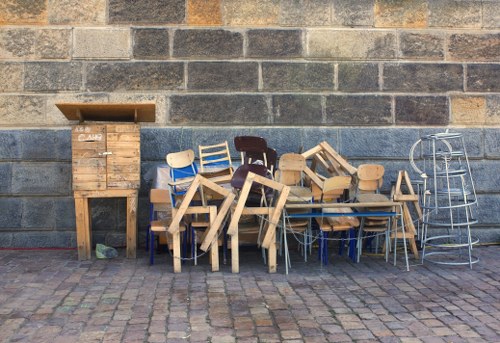
Many office clearances contain items that are not all in the same condition, so sorting them properly matters. Some furniture may be usable again, some equipment may need specialist treatment and some materials may simply be ready for disposal. We approach the work in a way that supports sensible separation, because mixed contents are easier to manage when they are categorised as the clearance progresses rather than at the end. That makes the result more orderly and more practical.
Office contents also include materials that need attention because of their format rather than their size. Paper archives, boxed files, old stationery stocks and layered storage can take time to check through. In some cases, those materials are straightforward general waste; in others, they are part of a planned office reduction where only selected items are leaving. The aim is not to overcomplicate the job, but to deal with the contents in the right way for the premises and the instruction.
For customers who want to understand wider responsible disposal options, our recycling and sustainability page explains the general approach, while waste removal covers broader mixed-load work when furniture is only one part of the clearance.
How quotations are usually prepared
Quotation requests are easier to prepare when they describe the type of premises, the main items involved and any access points that could affect removal. A brief list of furniture, storage, equipment and loose contents is often enough to start a meaningful estimate. If there are stairs, shared corridors, parking limits or restricted building times, those details help too. We do not need a long story, just enough information to understand the scope and shape of the work.
Photos can be useful when they show room size, item volume and any awkward items that need dismantling or careful handling. They are not always essential, but they often make it simpler to judge how the clearance will be carried out. If you already have a plan for what stays and what leaves, include that as well. Clear instructions reduce the chance of misunderstandings and make it easier to prepare a suitable quotation for the job in question.
When you are ready to compare service details, the contact us page is the right place for a direct enquiry, and the about us page gives a brief introduction to the business side of the service.
Office clearances for different premises
Not every office looks the same, and the service can be adjusted to suit different setups. A single-room office above shops may need a very different approach from a larger managed floor or a workspace with multiple departments. Clearances in shared buildings can involve coordination with building management, while a standalone office may be more straightforward but still require careful removal of bulky items. The important thing is that the plan matches the premises.
Some instructions are focused on a complete end-of-tenancy clear-out, while others only involve removing surplus contents and leaving the working office intact. Both can be handled as office clearance, but the sequence and priorities differ. In a partial clearance, the emphasis is on keeping the items that remain undisturbed and making sure desks, documents and essential equipment are not mixed with the outgoing load. That kind of selective work needs a steady, methodical approach.
If the job also includes the removal of extra contents from a domestic-style space, our home clearance page may be relevant, and premises with mixed storage or equipment outside the main office area can also involve garage clearance when those ancillary spaces need to be emptied at the same time.
About Tooting

Tooting is a district in south-west London within the London Borough of Wandsworth, located between Balham, Colliers Wood and Streatham. It is traditionally associated with Tooting Broadway and Tooting Bec, two Underground stations on the Northern line that give the area a clear urban structure and make it easy to recognise as a place with its own centre rather than a vague stretch of housing. The neighbourhood has long been shaped by a mix of residential streets, local commerce and public transport links, and it retains that layered character today. Tooting High Street is one of its best-known corridors, with a busy sequence of shops, services and food businesses that reflect the everyday life of the district. Nearby, Tooting Market and Broadway Market add to the area’s commercial texture, while the surrounding streets include Victorian and Edwardian terraces, later infill development and a range of apartment blocks. The area also has notable open space in Tooting Bec Common, a large green expanse with sports facilities, mature trees and walking routes that contrast with the density of the built-up streets nearby. Close by, the peaceful expanse of the lido at Tooting Bec has made the locality familiar to many Londoners over the years. Tooting’s history is visible in the way older housing, transport infrastructure and modern high street activity sit together, and the place has kept a strong local identity through its markets, parks and everyday street life rather than through grand civic buildings or a single central square.
Furniture removal and clearance choices

One of the main decisions in an office clearance is whether the furniture is being removed as a full set or piece by piece. Full-set clearances are often used when a workplace is closing, changing hands or being reconfigured entirely. Selective removal suits offices that are keeping part of their setup but need to lose older chairs, surplus desks or storage that no longer fits the layout. The right choice depends on the instruction, but in either case the work benefits from a clear inventory of what stays and what goes.
Furniture removal can also be shaped by condition. Items that are sturdy and usable may be handled differently from damaged or heavily worn pieces. Larger furniture sometimes needs to be dismantled to move it safely, and compacted loads may be more efficient once items have been separated by type. Our approach is designed to keep the process practical for the premises, rather than forcing every job into the same pattern. That flexibility is especially useful in offices with a mix of old and newer equipment.
For a related service route where furniture is the main focus, see office clearance again for the core commercial offer, and use pricing and quotes when you want to request an estimate after checking the likely scope. If you are ready to move ahead, send over the basics and ask for a quotation.
What to include in your enquiry
A useful enquiry usually includes the type of office, the main items to be removed and any unusual access issues. It helps to mention whether the job is a one-off clearance, a staged clear-out or part of a move-out process. If there are fragile items, fixed fittings that must remain in place or storage areas that need checking separately, note those as well. The more clearly the instruction is described, the easier it is to shape a sensible response.
There is no need to overstate the task. A straightforward list of rooms, furniture and contents is often better than a long general description. Where items are grouped into reception, meeting rooms, open-plan desks or back-office storage, that structure can be helpful. It gives a better sense of the load without creating unnecessary detail. If you are unsure what counts as part of the clearance, a brief note is usually enough to begin with.
You can also review related service pages such as house clearance for complete property clear-outs and builders waste clearance if the premises also include renovation debris or leftover materials from fit-out work.
Commercial clearances with a practical finish
Office clearance is not only about taking items away; it is also about leaving the workplace in a state that suits the next stage. That may mean clearing circulation space, separating reusable pieces, removing broken furniture and dealing with the last mixed items from cupboards, corners and storage rooms. A practical finish matters because it helps the property manager, landlord or incoming occupier take over without facing a pile of loose remnants.
We keep the service focused on the work that matters most in commercial settings: safe removal, sensible sorting and an orderly result. If the office contains a combination of general contents, furniture and redundant equipment, the simplest approach is usually to treat it as one coordinated clearance rather than a series of disconnected jobs. That avoids duplication and helps ensure the job is handled consistently from the first item to the last.
Need a quotation? Use the contact details on the site, or begin with the pages for contact us and pricing and quotes to move the enquiry forward in a simple way.